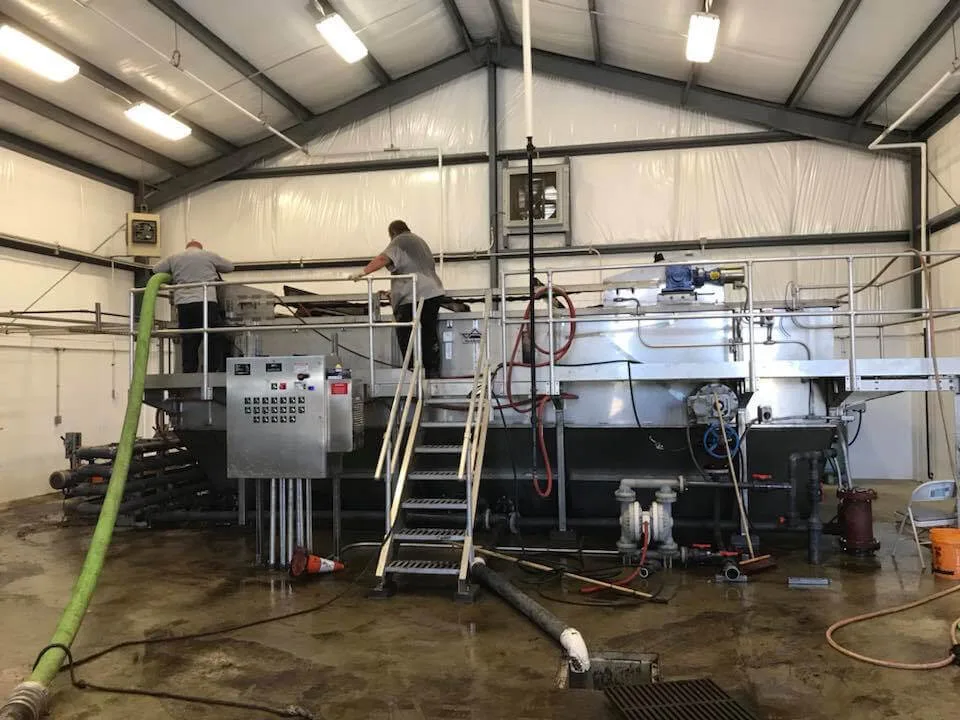
Scheduled pumping and maintenance for commercial kitchen grease traps across the Jackson metro.

A grease trap sits between a kitchen's drain lines and the building's connection to the sewer or septic system. Wastewater from sinks, dishwashers, and floor drains passes through the trap, where fats, oils, and grease (FOG) float to the surface and solids settle to the bottom. The clarified water in the middle flows out. Over time, the FOG layer thickens and the solids layer rises until the trap loses separation capacity and grease starts passing downstream.
Grease that reaches the main drain line coats the pipe walls, narrows the bore, and eventually blocks it. A blocked line shuts down the kitchen. A blockage that reaches the municipal sewer triggers a code violation, a fine, and a backup that can affect neighbouring businesses.
Regular pumping removes the accumulated FOG and solids before they reach that point. Hillard's has cleaned commercial grease traps across the Jackson metro for decades, working with restaurants, cafeterias, and institutional food service operations.
The vacuum truck draws out all FOG and solids. The technician scrapes the baffles and walls to remove adhered grease that pumping alone leaves behind.
With the trap empty, the crew checks the inlet and outlet pipes, the baffles, and the trap walls for damage or wear. A cracked baffle lets grease bypass the separation chamber entirely.
Hillard's records the volume pumped and the condition of the trap. Restaurants that need documentation for health department inspections or municipal compliance get a service record.
It depends on the kitchen's volume, the menu, and the trap's size. A high-volume restaurant frying food all day fills a trap faster than a cafeteria serving salads and sandwiches. Most commercial kitchens need service every one to three months. Waiting longer risks a blockage and a code issue.
Hillard's can set up a recurring schedule that matches your kitchen's usage. Scheduled service is cheaper and less disruptive than emergency calls when the line backs up during Friday dinner service.
Check with your local health authority for required pumping intervals. Municipal codes in the Jackson metro typically mandate that grease traps be serviced before the FOG layer exceeds 25% of the trap's working depth.